If you have noticed a gap through the middle of your abdomen after pregnancy, a ridge when you sit up, or a feeling that your core is weaker than it used to be, you may be wondering whether you have diastasis recti.
Diastasis recti is a widening of the connective tissue between the two sides of the rectus abdominis muscles. It is very common during pregnancy because the abdominal wall has to adapt as your baby grows.
You can perform a simple check for diastasis recti at home, but the size of the gap is only one part of the picture.
How the tissue feels, whether it develops tension, what happens when you move and whether you experience symptoms such as abdominal doming, back pain or pelvic floor problems can all be relevant.
This guide explains how to check for diastasis recti after pregnancy, what you may feel, what a home check cannot tell you and when a professional postnatal assessment may be useful.
A home check is not a diagnosis and should not replace appropriate medical assessment if you have pain, unexplained abdominal symptoms or concerns about your recovery.
What Is Diastasis Recti After Pregnancy?
Diastasis recti, sometimes called abdominal separation, describes a widening through the linea alba — the connective tissue running vertically down the centre of the abdomen.
The rectus abdominis muscles sit on either side of this tissue.
As pregnancy progresses, the abdominal wall stretches and adapts to accommodate the growing uterus. The distance between the two sides of the rectus muscles therefore commonly increases.
After birth, this separation may gradually reduce as the abdominal wall recovers.
For some women, however, a noticeable gap remains. You may also notice changes in how the abdomen feels or behaves when you sit up, lift, exercise or manage everyday tasks.
Diastasis recti is therefore not simply about appearance. It is also useful to consider how effectively the abdominal wall supports movement and manages pressure.
Why Abdominal Separation Happens During Pregnancy
During pregnancy, the abdominal wall is placed under gradually increasing stretch.
Hormonal changes also affect connective tissues throughout the body, while the growing uterus changes the position and length of the abdominal muscles.
These are normal adaptations.
By the later stages of pregnancy, some degree of widening through the midline is very common.
After birth, the tissues begin adapting again. Recovery varies between individuals and can be influenced by pregnancy, delivery, previous pregnancies, abdominal surgery, activity levels and the demands placed on the body after childbirth.
Having a gap after pregnancy therefore does not automatically mean something has gone wrong.
Why the Size of the Gap Is Only Part of the Picture
It is easy to become focused on the number of fingers you can fit between the abdominal muscles.
That measurement can be useful, but it does not tell the whole story.
Two people may have a similar width of separation but very different levels of function.
One may generate good tension through the midline, exercise comfortably and manage load effectively. Another may experience noticeable doming, weakness, poor pressure control or discomfort.
Assessment may therefore consider:
- Width of the separation
- Depth beneath the fingers
- Tension through the midline
- What happens when you breathe
- What happens when the abdominal wall engages
- Whether doming appears
- How the abdomen responds during movement
- Whether other symptoms are present
The goal is not simply to make the gap as small as possible. It is to understand how the abdominal wall is working.
How to Check for Diastasis Recti at Home
A simple home check can help you become more familiar with your abdominal wall.
It is best viewed as an initial screen rather than a definitive measurement.
Perform the test gently. Pressing deeply into the abdomen or repeatedly checking the gap is unnecessary.

Step 1: Lie Down and Relax Your Abdominal Wall
Lie on your back with your knees bent and your feet resting comfortably on the floor or bed.
Allow your abdomen to relax.
Try not to brace your stomach or deliberately pull your belly button towards your spine before checking.
You are initially trying to feel the resting tissues rather than creating as much tension as possible.
If lying flat is uncomfortable after birth or surgery, do not force the position.
Step 2: Find the Midline of Your Abdomen
Place two or three fingertips across the centre of your abdomen around the level of your belly button.
Your fingers should point across the body rather than down towards your feet.
Gently feel for the softer line between the two sides of the abdominal muscles.
The separation may not be the same all the way along the abdomen, so it is useful to check at more than one point.
Step 3: Gently Lift Your Head and Feel Above, At and Below Your Belly Button
Keeping your fingertips lightly on the midline, gently lift your head and shoulders a small distance from the surface.
You do not need to perform a full sit-up.
As the rectus abdominal muscles begin to engage, you may feel the edges of the muscles move towards your fingertips.
Notice roughly how much space you can feel between them.
Repeat the check:
- A few centimetres above the belly button
- At the belly button
- A few centimetres below it
There is no need to perform repeated full crunches simply to test the gap.
Step 4: Notice the Width, Depth and Tension
Rather than concentrating only on how many fingers fit into the space, notice several things.
How wide does the gap appear?
How deeply do your fingers sink?
Does the tissue beneath your fingers feel supportive or very soft?
Can you feel tension develop as the abdominal wall engages?
Does the abdomen remain relatively controlled, or does a ridge or dome push upwards?
These observations may be more informative than a finger-width measurement alone.
H2: What Should Diastasis Recti Feel Like When You Check It?
There is no single sensation that defines every case of diastasis recti.
You may feel a relatively narrow but deep space through the midline.
You may feel a wider separation with reasonably good tension underneath.
The tissues may feel soft at rest but become firmer when the abdominal wall engages.
This variation is one reason a home check has limitations.
Why Finger Width Is Only a Rough Guide

Finger width is an approximate home measure rather than a precise clinical measurement.
You may see advice online describing diastasis recti as a separation of two fingers or more, but everyone’s fingers are different sizes.
The pressure used when testing can also change what you feel.
Someone pressing firmly into a relaxed abdominal wall may record a deeper or wider-feeling gap than someone using light pressure.
If you want to monitor your abdomen over time, consistency is more useful than chasing an exact number. Try to use the same position, similar pressure and similar level of abdominal engagement each time.
What Depth and Tension Can Tell You
The connective tissue through the midline should be capable of developing tension when the abdominal wall is working.
If your fingers sink deeply with very little sense of resistance, that may suggest the tissue is not managing load as effectively in that position.
If you can feel tension developing beneath your fingers as you breathe and engage, that may provide useful information about abdominal wall control.
There is no simple pass-or-fail result.
At Sanderstead Osteopaths, our diastasis recti treatment in Sanderstead considers abdominal wall behaviour, movement and pressure management rather than focusing only on gap width.
Does Abdominal Doming Mean You Have Diastasis Recti?
Not necessarily.
Abdominal doming and diastasis recti are related, but they are not the same thing.
Doming describes the visible ridge or bulge that can appear along the centre of the abdomen when pressure pushes forwards through the abdominal wall.
You may notice it when:
- Sitting up
- Getting out of bed
- Performing a crunch
- Lifting your baby
- Planking
- Exercising
- Carrying something heavy
Someone with diastasis recti may experience doming, but doming can also be influenced by how the abdominal wall manages pressure during a particular movement.
The Difference Between Doming and Separation
Diastasis recti refers to widening through the midline.
Doming describes what the abdomen does when it is placed under load.
Someone can have a measurable separation without significant doming. Another person may have a relatively modest gap but show obvious doming during movement.
If you notice this pattern regularly, our guide to why your stomach domes when you sit up after pregnancy explains it in more detail.
Why Pressure Management Matters
The abdomen does not work in isolation.
The diaphragm, abdominal wall and pelvic floor help manage changes in pressure when you breathe, move, lift and exercise.
If you hold your breath, brace very hard or push pressure forwards through the abdominal wall, doming may become more noticeable.
The aim is not to constantly pull your stomach in. It is to develop coordination so the abdominal wall can respond appropriately as physical demand increases.
Common Mistakes When Checking for Diastasis Recti at Home
A home test can be helpful, but it is easy to become overly focused on the result.
Pressing Too Hard or Only Checking One Point
You do not need to push deeply into the abdomen.
Using excessive pressure can make the gap feel deeper and may make it harder to judge how much tension is present.
It is also worth checking more than one location.
The separation may be different above, at and below the belly button, so testing only one point can give an incomplete picture.
Assuming a Bigger Gap Means a Bigger Problem
A wider separation does not automatically mean poorer function.
Equally, a relatively narrow gap does not guarantee that the abdominal wall is working efficiently.
Questions such as these can be more useful:
- Can you manage everyday movement comfortably?
- Can you develop tension through the abdominal wall?
- Does the abdomen dome significantly?
- Do you have pain or pelvic floor symptoms?
- Can you gradually increase exercise load?
The measurement is useful information, but it should not be viewed in isolation.
Ignoring What Happens During Movement
A test performed while lying on your back only shows what happens in that position.
Your core also needs to function when you:
- Stand
- Walk
- Lift
- Carry
- Bend
- Squat
- Exercise
- Get up from the floor
If your abdominal wall looks controlled during a lying test but repeatedly domes during everyday movement, that is useful information.
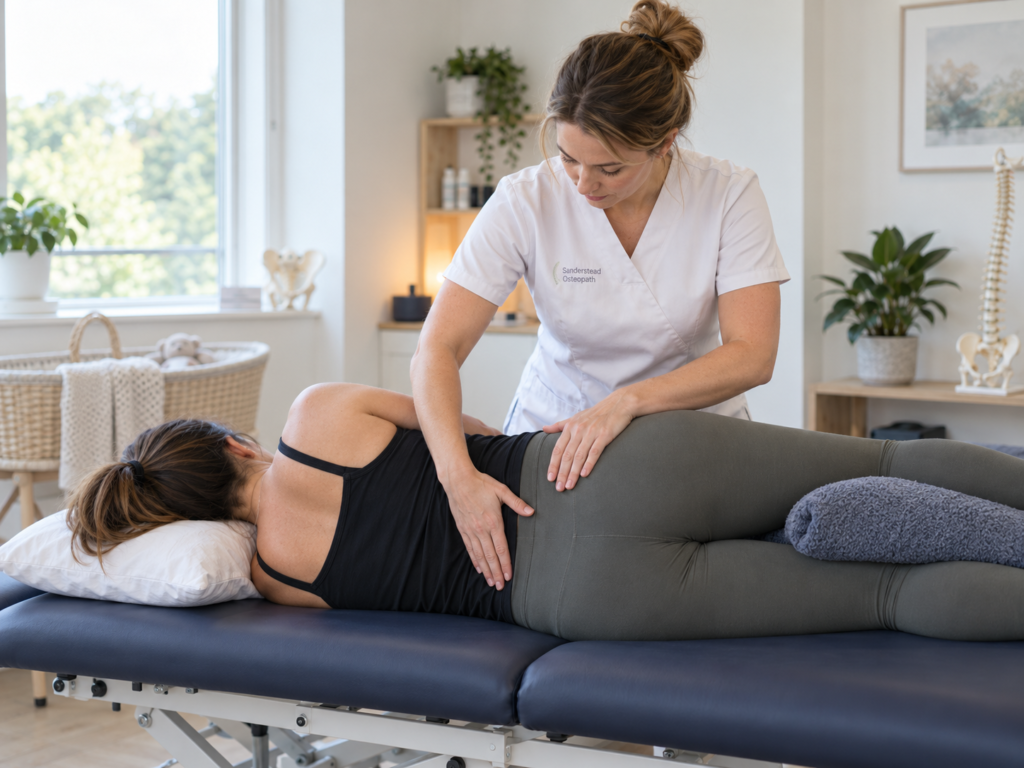
Professional assessment can therefore include functional movement rather than examining the gap alone.
What Can Help Diastasis Recti Improve After Pregnancy?
Many women see improvement in abdominal wall function after pregnancy.
Recovery does not necessarily mean completely eliminating the separation.
A more practical goal is to improve how well the abdominal wall supports movement and manages increasing load.
Why Recovery Is About Function, Not Just Closing the Gap
Your abdominal wall needs to help with everyday tasks such as lifting, carrying, changing position and exercising.
Someone can function very well with a degree of residual separation.
Conversely, someone with a small gap may still experience weakness or poor pressure control.
Rehabilitation should therefore be guided by what your body can do, not only by the distance between the abdominal muscles.
Breathing, Core Control and Progressive Strengthening
Early rehabilitation may involve learning how breathing and abdominal engagement work together.
From there, exercises can gradually become more challenging.
Progression may include:
- Controlled abdominal exercises
- Functional lifting
- Squats and lower-body strengthening
- Resistance work
- Pilates-based rehabilitation
- Gradual return to higher-load activity
The appropriate starting point varies from person to person.
If an exercise consistently causes pronounced doming or makes symptoms worse, it may be too demanding at that stage.
That does not necessarily mean the exercise must be avoided permanently. It may need to be modified and progressed gradually.
Our osteopathy and Pilates treatment may be relevant where controlled rehabilitation and progressive exercise form part of recovery.
When Should You Get Diastasis Recti Professionally Assessed?
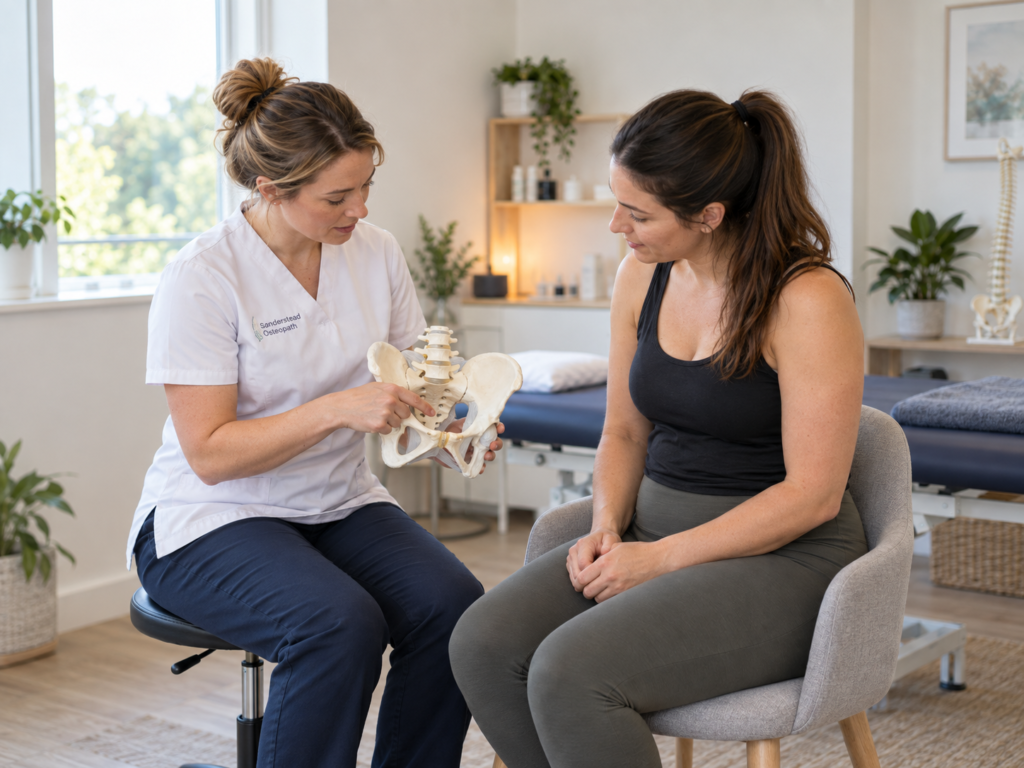
You do not need professional treatment simply because you can feel a gap.
However, assessment may be useful if you are concerned about how your abdominal wall is functioning or if other symptoms are present.
If You Have Doming, Weakness, Pain or Pelvic Floor Symptoms
Consider assessment if you experience:
- Persistent abdominal doming
- A core that feels unusually weak or disconnected
- Difficulty progressing exercise
- Lower back pain
- Pelvic discomfort
- Urinary leakage
- Pelvic heaviness
- Difficulty lifting or carrying
- Concerns after a C-section
These symptoms do not necessarily mean the diastasis itself is causing the problem. They may indicate that a broader postnatal assessment would be useful.
For pelvic symptoms, our pelvic floor recovery service looks specifically at postnatal pelvic floor function.
If lower back symptoms have become the main concern, you can also read about postnatal back pain treatment.
If You Are Unsure Whether Your Home Check Is Accurate
It is easy to repeatedly check your abdomen and become more confused rather than less.
You may be unsure:
- Whether you are feeling the correct tissues
- How hard to press
- Whether the separation is significant
- Whether doming is normal
- Which exercises are suitable
- Whether you are ready to progress
A professional assessment can provide a more complete picture.
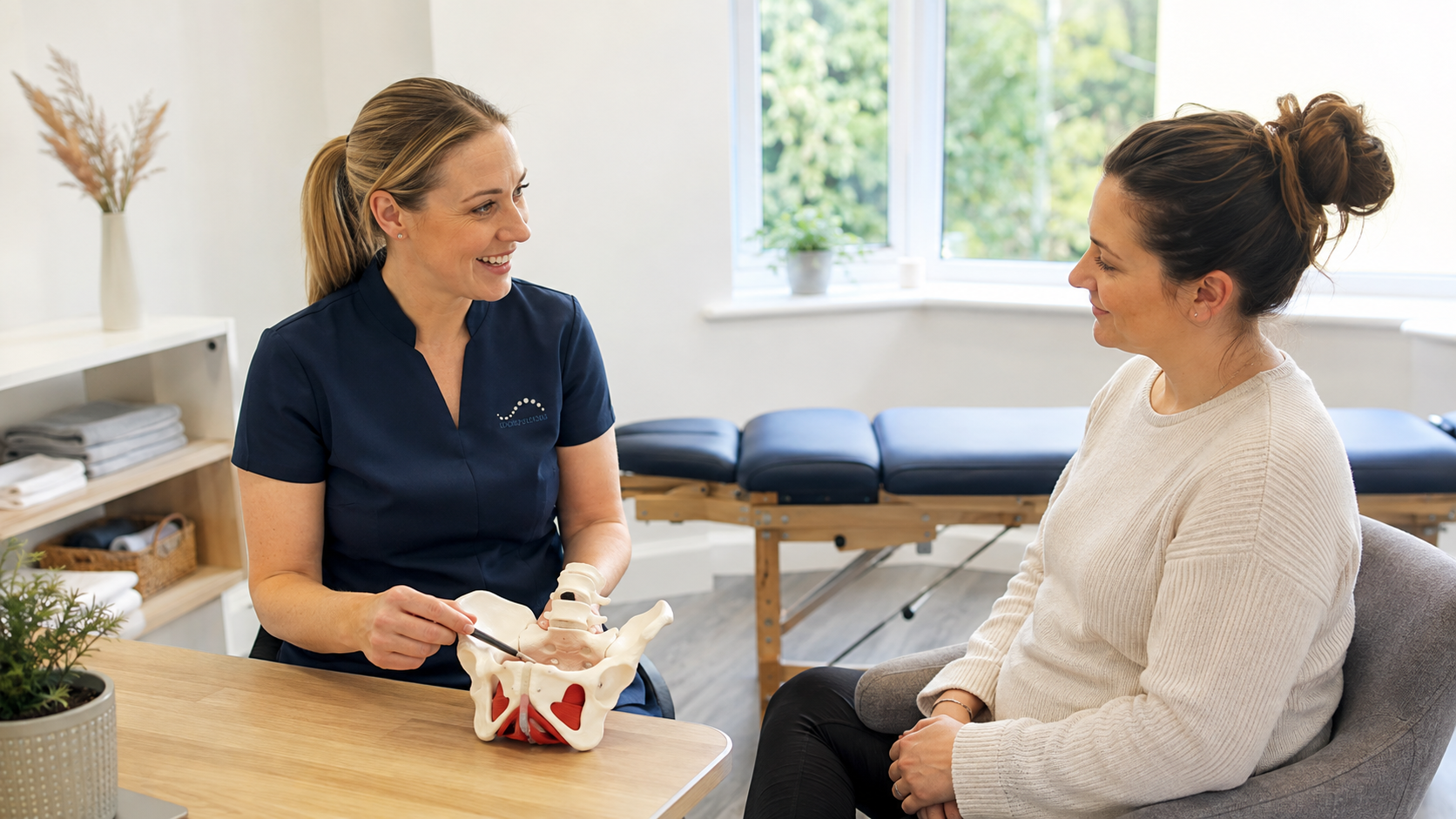
A Mummy MOT can assess abdominal wall function alongside posture, breathing, pelvic floor coordination and movement where appropriate.
Diastasis Recti Assessment in Croydon and Sanderstead
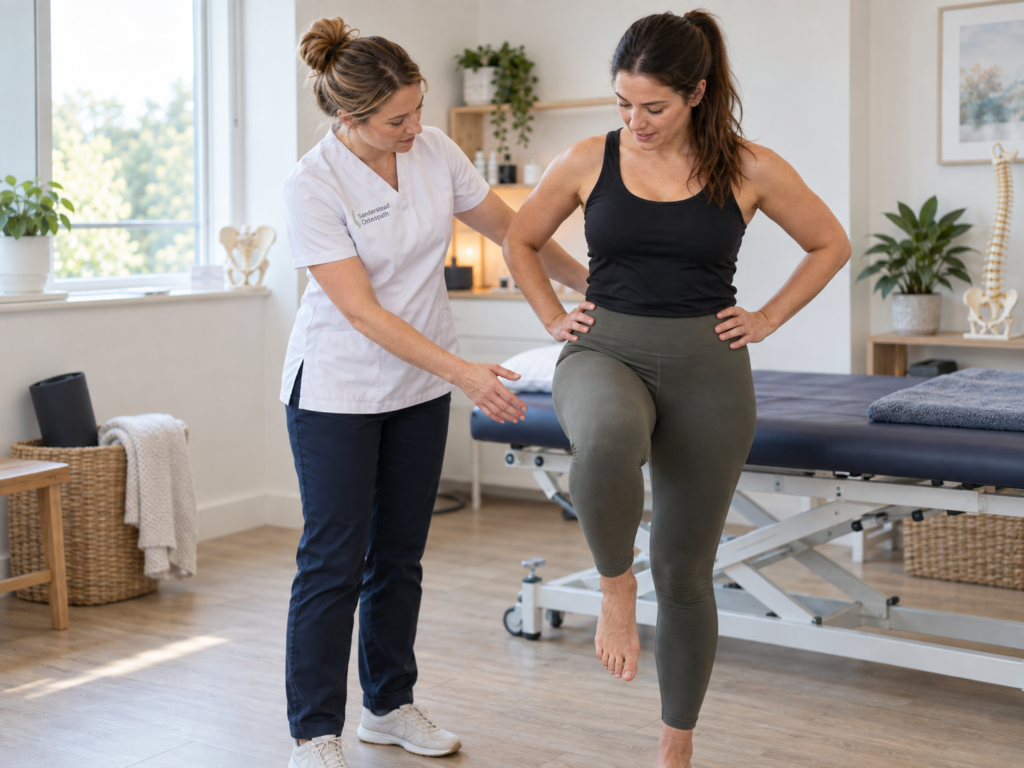
Sanderstead Osteopaths provides postnatal assessment and diastasis recti support for women across Croydon and the surrounding areas.
Patients visit the clinic from Sanderstead, South Croydon, Purley, Selsdon, Warlingham, Kenley, Coulsdon and elsewhere across Croydon.
Assessment does not simply involve counting the width of the gap.
Depending on your symptoms and stage of recovery, we may look at:
- The abdominal wall at rest
- Width and depth of the separation
- Tissue tension
- Doming during movement
- Breathing
- Pressure management
- Core control
- Pelvic movement
- Everyday functional tasks
- Exercise tolerance
The aim is to understand what your body can already do well and where additional support may be useful.
Your recovery plan may include exercise guidance, movement rehabilitation, breathing and pressure strategies, osteopathic treatment where appropriate, or progression back towards your normal activities.
You can find more information about our dedicated diastasis recti treatment in Sanderstead.
If your concerns are part of a wider postnatal recovery picture, a Mummy MOT assessment may be the more appropriate starting point.
Frequently Asked Questions About Checking for Diastasis Recti
How Many Fingers Is Considered Diastasis Recti?
Two finger widths is commonly used as a rough reference for abdominal separation, but it is not a definitive diagnosis.
Everyone’s fingers are different sizes, and width alone cannot tell you how well the abdominal wall is functioning.
Depth, tension, pressure control, movement and symptoms can all be relevant.
If you are concerned about what you feel, a professional assessment is more useful than repeatedly trying to achieve an exact finger measurement.
Can You Have Diastasis Recti Without a Visible Gap?
Yes. Diastasis recti may not be visually obvious while you are standing or resting.
Some women only become aware of it when they feel the abdomen or notice doming during certain movements.
Equally, visible abdominal doming does not automatically prove that you have a significant diastasis.
Assessment can help distinguish between the appearance of the abdomen and how the abdominal wall is functioning.
Can Diastasis Recti Improve Years After Pregnancy?
Yes. Abdominal wall function can often be improved long after pregnancy.
There is no rule that rehabilitation is only useful during the first few months after birth.
If you still experience doming, weakness, difficulty exercising or other symptoms years later, it may still be worthwhile assessing how your abdominal wall manages movement and load.
Should I Have a Mummy MOT If I Think I Have Diastasis Recti?
A Mummy MOT may be useful if your diastasis recti concerns occur alongside other postnatal symptoms such as pelvic floor problems, lower back pain, C-section scar tightness, pelvic discomfort or difficulty returning to exercise.
The assessment can look at the abdominal wall as part of the wider postnatal system.
If diastasis recti is your only concern, a more focused abdominal wall assessment may be appropriate instead.
If you are unsure which appointment is most suitable, you can contact Sanderstead Osteopaths for guidance.